Toronto’s transit authority, serving millions of people, sent a note letting me know my email address was included in a gigantic, accidental CC reply:
The disclosure was due to human error during the distribution of the email. Specifically, recipients' email addresses were visible to one another when the email was sent.
So what did they do?
Sent another mass email with this simple request:
We are requesting that all recipients permanently delete the email from their inboxes, sent folders, deleted items, archives, and any other storage locations, and refrain from further using, sharing, copying, or disclosing any email addresses contained within the message. We appreciate your cooperation in helping to protect the privacy of all affected individuals.
Problem solved.
Phew.
Hoping they can solve the streetcar delay issues just as easily.
Postscript
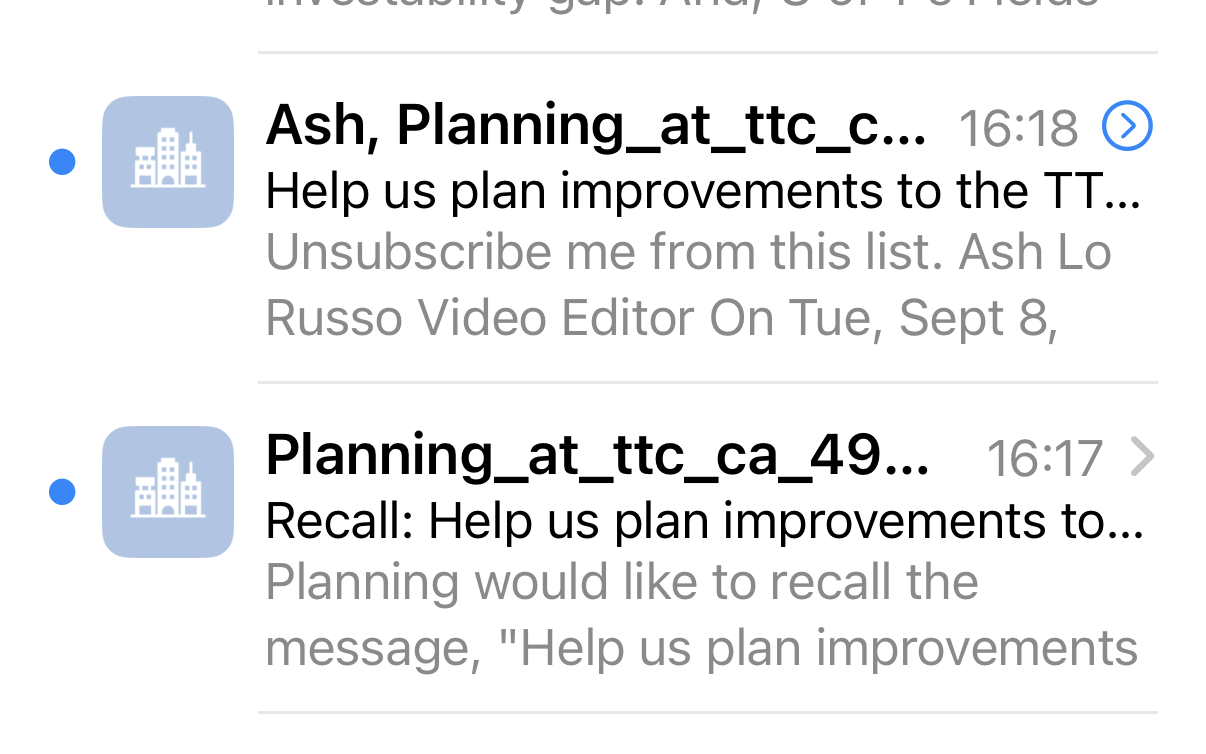
At least they did try to recall the email after sending it (there were 500 addresses on the message I got…).
He saw the best minds of his generation burn like fabulous roman candles (to mix literary clichés).
Sixty-nine years ago today, his second book was tragically celebrated, seventy-nine years after the events it depicted.
And today I biked through my old university campus.
I would never have been there when I was had I not followed his footsteps to, in our youth, study writing in the heart of our Big Cites.
Through his works I found the way again, which meant I was able to find everything else again.
I’ve read his words blurry-eyed while riding buses across the continent and sitting in smoke-filled cafés.
I’ve read his words translated again into foreign languages I almost speak.
(Amazing how much those letters typed on a continuous scroll of paper resonated despite the problematic prose they created.)
Despite all that, it wasn’t him, but a remembrance of him abstracted through distant observers’ silent performances (and sonic ones, too) that shifted my gaze to this famous story of a first-generation immigrant’s time on the road.
And
today
I still know,
as I’ve always known,
(even before I was born)
that God
truly
is
Pooh Bear
Quick, raw, take:
Pecorino romano cheese (or good Parmigiano Reggiano) plus aged prosciutto (and maybe with some seasonal fresh fruit or veg) = best simple pleasure in the world.
Especially with the crunch of good tarallini (or even just roasted almonds).
I tried to copy a suggestion for an AI prompt from LinkedIn on my iPhone to share with myself via email.
LinkedIn wouldn’t let me copy the text.
So I took a screenshot — and then used Apple’s built in OCR technology to copy the text I wanted.
LinkedIn prevented me from making use of the value its network provides. Once again, then, I turned to one of Apple’s best (and most underrated) features to do what I wanted. A perfect example of how one company’s loud use of AI misses the mark while another’s “boring” implementation does what people need.
(Every time I use “Live Text” I feel like I’m living in the future. Silly, I know. But also reliably true.)
I subscribed to the RSS feeds for Steven Johnson and Tim Wu, amongst others, as generated by their Medium accounts. Or rather, their former Medium accounts.
At some point, the accounts of Johnson and Wu (at least) were taken over by people clearly not them.
Ironically, it took me a bit to notice as both have plausible reasons for the noise the feeds introduced. I could imagine Johnson experimenting with short stories, or Wu trying to broaden his ideas by publishing in Chinese.
Much like Meetup was, on more focused attention, it was clear their accounts were hijacked.
I don’t know if it was because they were hacked or the original authors let them go dormant, but it’s again a reminder of what people will do to gain an audience. (Or maybe it was the fault of Matter’s aggregator that confused them, but still.)
fwiw, Wu’s Wikipedia linked “official site” has been removed and Johnson’s official site has vanished, too.
Shortly after NASA released the Artemis II photos, I vibecoded a little tool to allow me see a new image of the Moon (or Earth) every day.
John D. Boswell decided to make a short film of them instead.
I’m glad he did.
Colossal
Twenty plus years ago, I was deep in the world of web standards. The work felt important, but was a very niche calling.
The effort itself was the definition of grassroots. A bunch of like-minded people getting together to make the place they congregated better. In hindsight, it’s hard to see the influence we had because those ideas championed are now a ubiquitous part of the modern landscape.
Reading that history, reflected back to the world in a whole new context was both oddly dissonant and inspiring.
The story told, while true, is burnished with the language of a legend. Still, if this story-myth can help energize a new generation to make their — our — world a better place, too, then I know Zeldman will be pleased.